Available
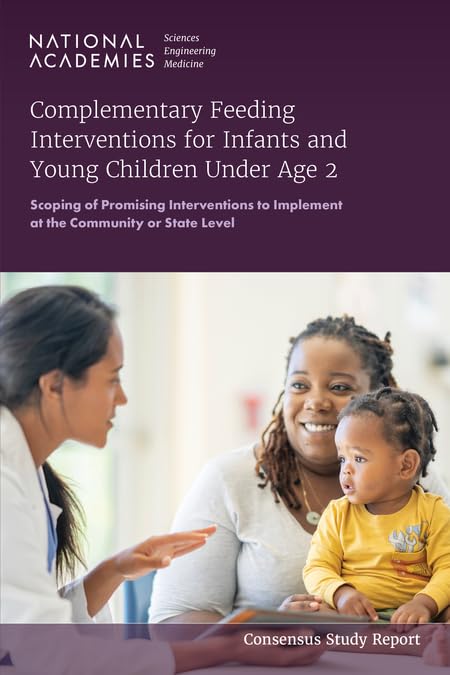
Complementary Feeding Interventions for Infants and Young Children Under Age 2
Complementary Feeding Interventions for Infants and Young Children Under Age 2
Couldn't load pickup availability

ISBN
ISBN
9780309710176, 0309710170
Authors
Authors
Committee on Complementary Feeding Interventions for Infants and Young Children Under Age 2, Food and Nutrition Board, Health and Medicine Division, National Academies of Sciences, Engineering, and Medicine
Publisher Date
Publisher Date
December 16, 2023
Publisher
Publisher
National Academies Press
Page count
Page count
486
Complementary feeding is the introduction of foods other than human milk or formula into an infant’s diet, typically beginning around 6 months of age. Recognizing the importance of optimal complementary feeding for growth, development, and long-term health, the National Academies Health and Medicine Division convened the Committee on Complementary Feeding Interventions for Infants and Young Children under Age 2. This consensus study conducted a scoping review of peer-reviewed literature and publicly available information on interventions in the U.S. and other high-income countries. The interventions were implemented across a variety of settings, including healthcare systems, early care and education programs, university cooperative extensions, WIC programs, and home visiting initiatives. The study provides a framework to inform evidence-based interventions that could be scaled or implemented at the community or state level to improve complementary feeding practices.
Key Features:
- Scope: Examines complementary feeding interventions in infants and young children under 2 years across multiple settings.
- Evidence-based: Summarizes peer-reviewed research and other publicly available studies.
- Diverse settings: Includes healthcare systems, early childhood education, WIC, home visiting programs, and community-based interventions.
- Scalability focus: Evaluates which interventions could be effectively expanded at community or state levels.
- Practical guidance: Offers considerations for designing, implementing, and scaling interventions to improve complementary feeding behaviors in the U.S.
- Comprehensive documentation: Includes appendices detailing committee biographies, literature search strategies, data extraction criteria, and tables summarizing interventions and scalability assessments.